
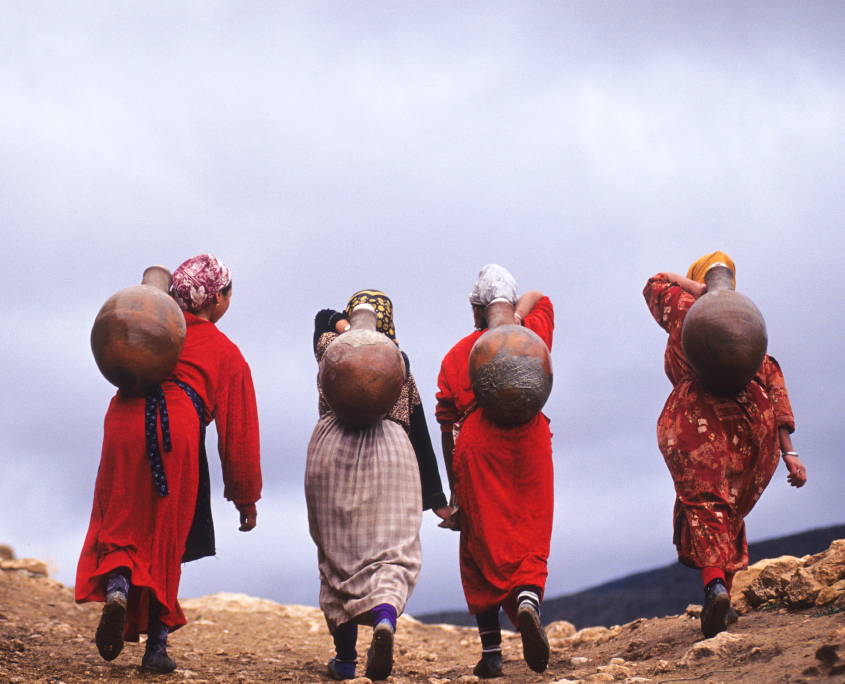
Women carrying spring water in High Altas, Mororcco.
Photo credit: Goupi Christian/Robert Harding via Getty Images
World Rural Development Day
Building cities that remember
When people talk about urban development, the conversation usually centres on what can be seen: roads, housing, water systems, markets, schools, and public transport. These are the visible markers of progress, and rightly so. They shape how people live, work, and connect with one another. Yet another form of infrastructure receives far less attention, despite being just as important to the long-term success of a town or city. It is building a body of knowledge.
Across many developing regions, rural settlements are growing into trading centres, towns, and eventually urban hubs at an unprecedented pace. As they expand, considerable effort is invested in constructing the physical systems needed to support larger populations. Far less attention is given to documenting how these places evolve, why key decisions are made, what challenges are encountered, and which solutions prove effective.
The consequence is that each generation of leaders, planners, and citizens often begins with incomplete knowledge of the place they are trying to develop. Valuable lessons disappear as administrations change, institutional memory fades, and community experiences remain undocumented. Progress continues, but too often without the benefit of accumulated understanding.
Just as roads connect places, documented knowledge connects generations. Imagine a town that maintains a living record of its development. It captures not only maps and infrastructure plans, but also the reasoning behind planning decisions, the evolution of local industries, environmental changes, demographic trends, community priorities, and lessons learned from both successes and setbacks. Such a record becomes more than an archive; it becomes a practical resource that informs future decisions.
This is what knowledge repository looks like. Its value extends far beyond preserving history. It enables continuity in governance by ensuring that incoming leaders understand the context behind existing policies and investments. It strengthens accountability by providing a transparent record against which commitments and outcomes can be assessed. It supports better planning by allowing future decisions to build upon evidence rather than assumptions.
Builiding, retaining and documenting knowledge also helps communities retain their identity as they urbanise. Growth inevitably changes a place’s physical character, but it need not erase the stories, traditions, and local knowledge that shaped it. By documenting these alongside physical development, urbanisation becomes an extension of a community’s journey rather than a departure from it.
Perhaps most importantly, documented knowledge transforms experience into an asset. Every community experiments, adapts, and learns. Some initiatives succeed while others reveal valuable lessons through failure. Unless these experiences are captured and shared, they remain isolated moments rather than becoming collective wisdom. Over time, this results in repeated mistakes, duplicated effort, and missed opportunities to build on what has already been learned.
The same principle applies to investment. Reliable records of population growth, infrastructure expansion, environmental conditions, economic activity, and governance priorities reduce uncertainty for public institutions, private investors, and development partners. Decisions become more informed when grounded in an evolving understanding of place rather than in snapshots in time.
As rural communities continue their transformation into urban centres, the question should extend beyond whether they are building enough infrastructure. It should also interrogate whether they are building enough knowledge.
The most resilient cities of the future may therefore be those that leave behind more than roads and buildings. They will leave behind a well-documented understanding of who they were, how they changed, what they learned, and why certain decisions mattered. In doing so, they will ensure that every generation inherits not only a more developed place but also a stronger foundation from which to continue building.

