
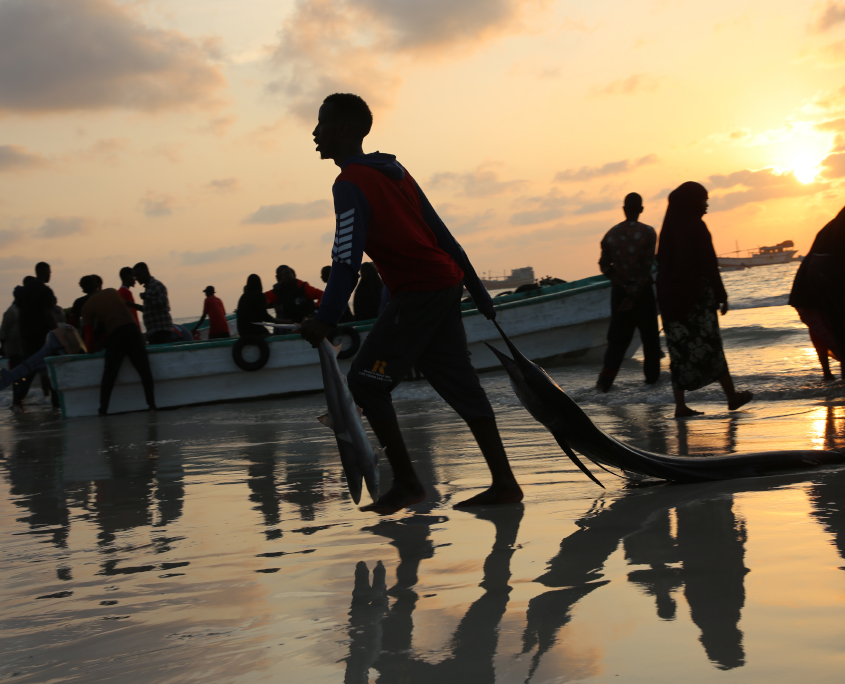
Photo Credit: Abuukar Mohamed Muhidin/Anadolu via Getty Images
International Day for the Fight against Illegal, Unreported and Unregulated Fishing
Why Africa’s fisheries crisis demands public attention
The crisis of illegal, unreported, and unregulated (IUU) fishing in Africa is not simply an environmental problem unfolding far out at sea. It is a deeply interconnected economic, political, and social challenge that reflects the broader struggle of balancing economic growth with ecological sustainability and livelihood protection. Across the continent, millions of people depend directly or indirectly on fisheries for employment, nutrition, and income, while governments rely on the sector for export earnings, foreign exchange, and economic growth. Yet the same drive to maximise economic returns is contributing to the overexploitation of aquatic ecosystems at a pace many fisheries can no longer sustain.
At the centre of this challenge lies a difficult question: how can African countries benefit economically from their marine and freshwater resources while ensuring these ecosystems remain productive for future generations? IUU fishing exposes the fragility of this balance. Illegal operations often bypass conservation rules, quotas, and reporting systems, accelerating the depletion of fish stocks and undermining legitimate fishing economies. The result is not only environmental degradation but also rising food insecurity, economic losses, and growing instability in coastal communities.
Despite the seriousness of the issue, much of the discussion around fisheries sustainability remains confined to technical policy circles, donor reports, and specialist environmental institutions. As a result, the broader public often does not fully understand the scale of the crisis or how deeply it affects everyday life. Yet fisheries decline is not an isolated “marine issue.” It influences food prices, household nutrition, employment opportunities, migration patterns, youth livelihoods, and even social tensions within coastal regions. Framing the issue purely through the lens of conservation risks overlooking these wider human realities.
This is why documenting, reporting, and opening public discussions on IUU fishing and fisheries sustainability are so important. Public visibility can transform invisible problems into issues that demand accountability and action. IUU fishing often occurs beyond public scrutiny, at sea, across borders, through opaque licensing systems, and within hidden supply chains. This invisibility allows illegal practices to continue with limited oversight. Investigative journalism, research, and public-facing analysis can expose corrupt licensing arrangements, exploitative labour practices, ecological destruction, and the enormous economic losses suffered by African states and communities.
Beyond exposing wrongdoing, strong reporting also helps connect environmental degradation to broader development concerns. When communities understand that declining fish stocks directly affect livelihoods, food security, and economic stability, fisheries governance becomes recognised not merely as an environmental issue, but as a matter of economic justice and political responsibility.
Effective documentation also strengthens institutional accountability. Public information creates pressure for governments to improve enforcement systems, increase transparency in fishing agreements, strengthen regional cooperation, and hold illegal operators accountable. Similarly, research institutions and universities can generate evidence that informs legislation, policy reforms, and investment priorities. Policymakers often recognise that fisheries governance is weak but lack reliable data, integrated analysis, or sustained public pressure to drive meaningful reform.
Importantly, communities themselves, the fishers, cooperatives, women fish processors, and local leaders possess deep knowledge about changing fish populations, ecosystem degradation, and unsustainable industrial practices. Documenting these lived experiences ensures that local knowledge becomes part of policy discussions and that solutions are grounded in social realities rather than imposed externally.
However, awareness alone is not enough. Documentation and public discussion only become transformative when they feed into policy processes, strengthen advocacy efforts, encourage institutional accountability, and build long-term public engagement. Otherwise, IUU fishing risks becoming another widely documented African crisis without a structural response.

