
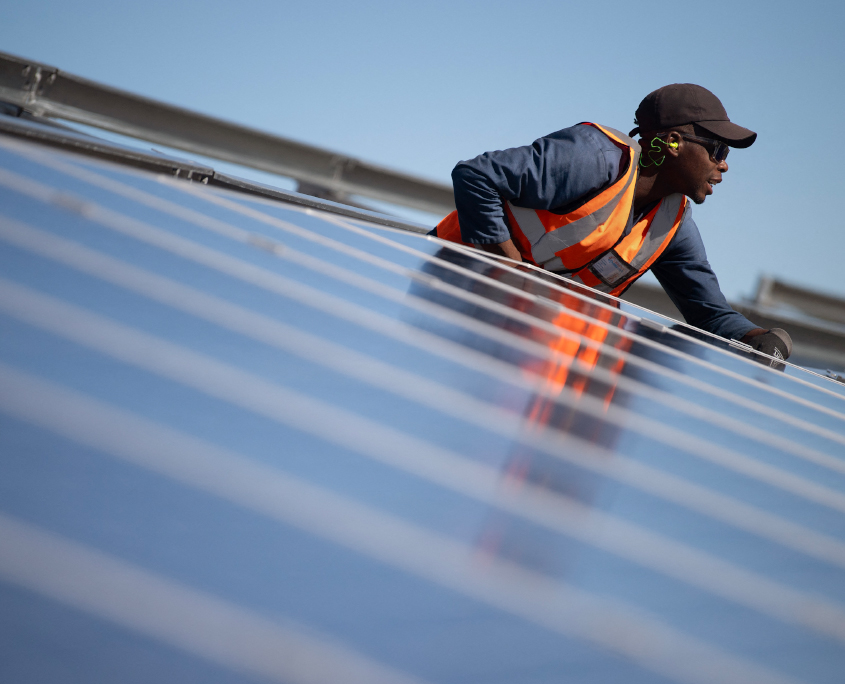
Photo Credit: Rodger Bosch/AFP via Getty Images
World Environment Day
The persistent gap between environmental policy and its implementation
African countries have, over the past several decades, demonstrated a consistently strong rhetorical and policy-level commitment to environmental protection, climate action, and sustainable development. This commitment is evident in continental frameworks such as the African Union’s Agenda 2063 and the African Ministerial Conference on the Environment (AMCEN), as well as through participation in global agreements such as the Paris Agreement and the Convention on Biological Diversity. Many countries have also adopted national climate change policies, reforestation programmes, renewable energy targets, and land restoration initiatives.
Yet, despite this impressive architecture of commitments, translating policy ambition into sustained, concrete action on the ground remains a challenge. The gap between policy and implementation is not unique to Africa, but it is often more pronounced due to intersecting social, economic, and political constraints that shape development priorities and governance capacity.
Many governments have also integrated environmental concerns into national development planning. Countries like Kenya, Rwanda, and Ethiopia, for instance, have advanced policies on plastic bans, renewable energy adoption, and reforestation. These efforts signal a shift toward greener development pathways, often supported by partnerships with international organisations and development banks.
However, translating these commitments into tangible outcomes on the ground remains uneven. In many cases, policies are well-designed but underfunded, weakly enforced, or fragmented across institutions. Further, environmental agencies often lack the financial and technical capacity to implement programmes at scale, particularly in rural and marginalised areas where environmental degradation is most severe.
Infrastructure deficits also play a role. Renewable energy expansion, sustainable agriculture, and waste management systems require significant capital investment, which is often constrained by competing development priorities such as healthcare, education, debt servicing, and basic infrastructure.
Socially, many communities depend directly on natural resources for survival through agriculture, fishing, forestry, and pastoralism. As a result, environmental policies that restrict land use, logging, or grazing without providing viable alternatives can face resistance or unintended social hardship.
Population growth, rapid urbanisation, and youth unemployment further complicate the picture. Expanding cities generate increasing waste and energy demand, while rural areas may experience intensified land pressure, leading to deforestation or overgrazing. In such contexts, environmental protection cannot be separated from broader questions of livelihoods and social protection.
Economic realities often force governments to balance long-term environmental goals with immediate development needs. Extractive industries such as mining, oil, and gas remain central to many African economies, providing revenue and employment. Transitioning away from these sectors requires careful planning to avoid economic shocks and job losses.
At the same time, limited fiscal space restricts investment in green technologies and climate adaptation infrastructure. While international climate finance exists, access is often complex, slow, and insufficient relative to need.
Political considerations also shape environmental action. Short electoral cycles discourage long-term environmental investments whose benefits may not be immediately visible. In some contexts, weak enforcement of environmental regulations can be linked to governance challenges, including corruption, institutional overlap, and limited regulatory authority at the local level. Moreover, environmental issues are sometimes politicised, especially where land use, conservation areas, or resource extraction intersect with local power structures and community interests.
Therefore, bridging the gap between commitment and implementation requires a multi-layered approach. First, strengthening institutional capacity is essential, particularly at the local government level, where implementation occurs. Second, environmental policies must be more closely integrated with development planning, ensuring that climate action supports livelihoods rather than competing with them.
Third, financing mechanisms need to be scaled up and simplified to enable African countries to access more predictable climate finance. Finally, community participation is critical, considering environmental initiatives are far more successful when local populations are actively involved in design, ownership, and benefit-sharing.
The implication of this is that strengthening the bridge between environmental ambition and action in African countries will require coordinated efforts. These must place people, livelihoods, and governance at the centre of environmental transformation.

